DOG in Conversation:
The World of Birds between Art
and Science
Five Questions for Dr. Corinna Langebrake
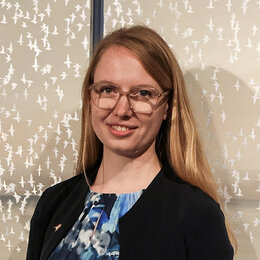
Dr. Corinna Langebrake combines her enthusiasm for birds with scientific research and artistic work. She has been a member of the DOG for ten years. The Wadden Sea and bird migration play a central role in her work; however, her motifs extend far beyond that.
DOG President Dorit Visbeck-Liebers met her at the beginning of October at two events: an evening lecture on bird migration research at the State Museum of Nature and Man in Oldenburg and at the preview of her exhibition “A Bird Painter between Art and Science” at the UNESCO World Natural Heritage Wadden Sea Visitor Center Wilhelmshaven. The accessible insight into the research and the variety of artistic techniques provided the occasion for this conversation.


Left: Corinna Langebrake at the exhibition opening “A Bird Painter Between Art and Science” in front of her painting “Watt from a Bird’s-Eye View” at the Wadden Sea Visitor Center in Wilhelmshaven. Right: Poster for the exhibition “Bird Painter Between Art and Science” in the Wadden Sea National Park
Interview
October 10, 2026
Dorit Visbeck-Liebers for the German Ornithological Society (DOG)
Dear Corinna, last week I saw you in two very different roles: as a scientist in your lecture in Oldenburg and as an artist at the preview of your exhibition in Wilhelmshaven. How did your enthusiasm for birds begin - and when did research and art come into it?
Ever since I can remember, birds have fascinated me. I think that has a family background: both my grandfather and my father are/were amateur ornithologists. They brought me close to nature and took me on many birdwatching excursions. From an early age, I started drawing, especially my two cockatiels. In third grade I illustrated and wrote my first “bird book,” in two parts! I further professionalized my art because of a suggestion from my boss during my voluntary year. He advised me to apply for the MoVo (Modern Bird Pictures) exhibition in Halberstadt. My voluntary year at the NABU Bird Protection Center in Mössingen (Baden-Württemberg) made it very clear to me that I wanted to study biology in order to learn as much as possible about ecosystems, evolution, and of course birds. I then realized how much I enjoy scientific work during my biology studies at the University of Greifswald and while working on my bachelor’s thesis.
In your lecture, you gave us a very vivid introduction to bird migration research. Which scientific questions are particularly important to you, and is there a finding from your own research that still fascinates you today?
In my scientific work, the main focus is on the question of how migratory behavior in birds evolved and what the genetic basis of this behavior is. To investigate these questions, I use both genetic data and observations from nature, for example by attaching small data loggers to birds that record migratory behavior. What I find particularly fascinating is the great flexibility with which each species adapts to the challenges of being a migratory bird. The behavior can appear very similar to us on the surface, yet migratory birds are sometimes separated by 55 million years of evolutionary history! How can this high precision of migratory routes and similar behavior arise independently multiple times? I am currently pursuing this question as a postdoctoral researcher at the Institute of Avian Research in Wilhelmshaven.
Your exhibition “A Bird Painter Between Art and Science” combines these two sides of your work. Does research change your perspective as an artist - and conversely, when working artistically, do you discover anything that also inspires you to think further scientifically?
I think that both disciplines begin with a close look and an understanding of the subject. As a scientist, I am fascinated by what lies behind the scenes; I want to understand how everything fits together, why, for example, a behavior is so pronounced as we can observe it. This curiosity also drives me in my artistic work. In some pieces, for example, I want to depict the behavior or history of a species. Then I sometimes spend a long time thinking and planning which methods and media I can use to do this as justice as possible. I think that idea generation plays a major role in both disciplines - for me, it is the same process in research and in art. Whether I am thinking about a new painting or about interpreting new results: creative thinking and being able to let go of conventional structures is, for me, the key.
I was surprised by the variety of your techniques: in addition to drawings and watercolors, there are collages, cut-out silhouettes, and works that gain spatial depth through multiple layers. How does such a piece come about - and how do you decide which technique suits a bird or a story?
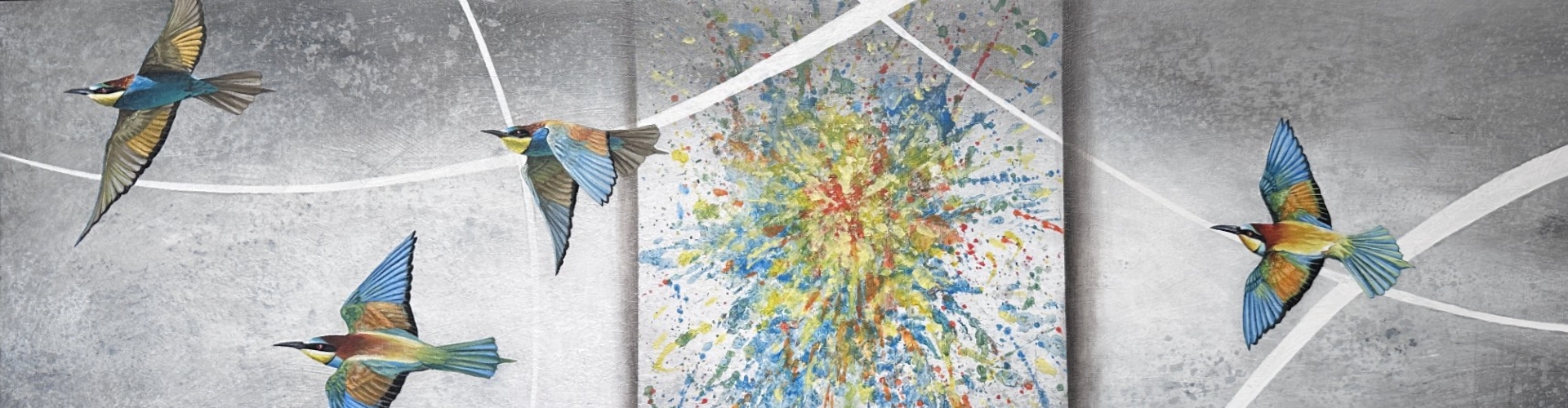
Most works begin with an experience in nature or an association. Sometimes I then think for many months about how I can depict a particular behavior. For this exhibition, representing movement and time was an important point. Movement can be shown, for example, through blur, through free line work, or through a series of different positions. Temporal dimensions are not so easy; they are different layers that slowly fade or become more concrete. In the end, I discovered a new medium for myself: individual acrylic glass sheets layered on top of one another give the image depth and capture both movement and the temporal dimension. In another picture, I wanted to depict the beautiful, shimmering flocks of sanderlings in the Wadden Sea. I thought and experimented for a long time about which medium could best represent this effect and therefore spent a lot of time working with reflective surfaces. So a great deal of “research” always goes into the artistic process before the right technique and representation are found.
With your lectures and images, you also reach people who have previously had little to do with birds. What do you want to inspire in them - and what possibilities do you see for the DOG to connect art and science more closely?
I think that access to our nature and to birds begins with fascination. Through my work and lectures, I want to pass on a little of my own fascination to people. I believe that this enthusiasm is the best foundation for protecting our natural world and paves the way for taking your own steps in that direction. For me, enthusiasm for birds is based above all on the fact that I have some background knowledge and can repeatedly learn from specialist literature what extraordinary feats they are capable of. Making these findings visible and understandable to the public is a very powerful tool. In the future, the DOG could perhaps partner with an art faculty and collaboratively illustrate and communicate specific, outstanding projects. Such partnerships exist at some universities and institutes and always result in wonderful outcomes.


Left: display case in the exhibition. Top right: at the exhibition opening (from left to right) Klaus Ritter (curator at the WattBZ), Dr. Juliana Köhler (head of WattBZ), Miriam Liedvogel (director of the Institute of Avian Research, Heligoland Bird Observatory), Peter Südbeck (head of the National Park Administration). Bottom right: detail of a work by Corinna Langebrake “Ice Duck”


Excerpts from works by Corinna Langebrake at the exhibition “A Bird Painter Between Art and Science” at the Wadden Sea Visitor Center in Wilhelmshaven. Top left: Dunlin, top right: Crane Dance, bottom left: Murmuration, bottom right: Red-tailed Black Cockatoo
About the person
Dr. Corinna Langebrake is a biologist and bird painter. She studied in Greifswald and earned her doctorate under Prof. Miriam Liedvogel at the Institute of Avian Research in Wilhelmshaven. After working for the Wadden Sea National Park Administration, she now conducts research as a postdoctoral researcher at the Institute of Avian Research in Wilhelmshaven in the excellence cluster NaviSense on the evolution and genetics of bird migration. Artistically, she is also particularly engaged with the Wadden Sea and its migratory birds. She has been a member of the DOG since 2016.