


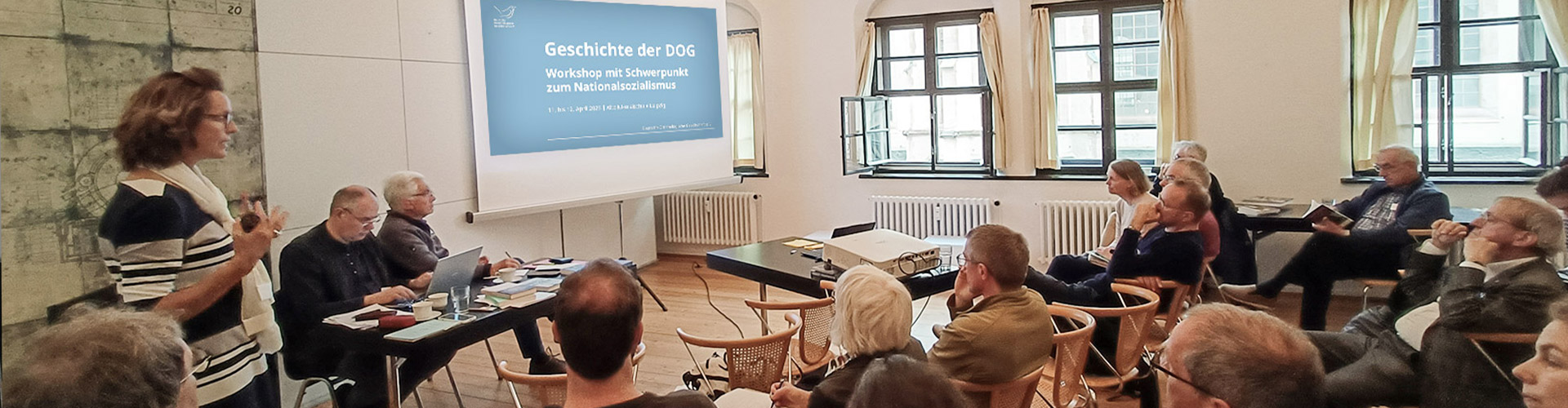

Photo of all participants in the history workshop in Leipzig (from left to right): Annsophie Schmidt, Jens Hering, Nils Franke, Wolfgang Benz, Mrs. Benz, Wolfgang Fiedler, Dorit Visbeck-Liebers, Till Töpfer, Bernd Haubitz, Karl Schulze-Hagen, Sabine Hackethal, Carmen Röhr, Dirk Tolkmit, Carla Bömeke, Franziska Tanneberger, Ina Heumann, Sabine von Mering, Wolfgang Mädlow, Elke Brüser, Peter Herkenrath, Dieter Kronbach, Klaus Nottmeyer, Sylke Frahnert, Matthias Laurisch (Hildegard Eissing is absent)
Workshop on the History of the DOG with a Focus on National Socialism
On April 11 and 12, approximately 25 experts, guests, and members of the DOG gathered for a two-day workshop at the Alte Nikolaischule in Leipzig—an impressive venue in the historic old town. The meeting centered on exploring and engaging with the history of the German Ornithological Society, with a clear focus on the Nazi era.
The workshop was opened by President Dr. Dorit Visbeck-Liebers. Right from the start, she set a very personal tone and made it clear that this is not about “the” history, but about our history—and that it affects every single one of us, including those within the DOG.
The first substantive presentation was given by Prof. Dr. Wolfgang Benz, who traced a broad historical arc—from the entanglements of individual actors in the Nazi state to how these issues were addressed in the decades that followed. I will personally remember his concluding plea for a conscious culture of remembrance and an open—yet humble—approach to our own history particularly vividly.
PD Dr. Nils Franke then placed the DOG in a broader context and demonstrated how other scientific societies deal with their past. Examples such as the German Alpine Club, BUND, and NABU made it clear that coming to terms with the past is most effective when it is made visible and also publicly contextualized. This had a very concrete impact—while at the same time highlighting the challenges of this issue.
Dr. Ina Heumann from the Museum für Naturkunde Berlin shared insights from her practical experience and impressively underscored the importance of interdisciplinary collaboration. Her references to less obvious contexts—such as war zones as collection sites and connections to the colonial era—added fascinating perspectives.
After such a wealth of input, it was nice to round off the first day with a short city tour in bright sunshine—and later to let it all sink in a bit over antipasti and good conversation.
On the second day, the focus was initially on the presentation by Dr. Nils Franke and Klaus Nottmeyer on the life of Günther Niethammer. The examination of his role as an ornithologist, as president of the DOG, and as part of the Nazi system sparked a lively and moving discussion—at times controversial, but always respectful and very constructive.
In the joint closing session, moderated by Dr. Dorit Visbeck-Liebers, the many perspectives were brought together once again, and initial ideas for the next steps were gathered.
There was agreement to continue the process that had begun and to establish a working group for this purpose. This is not just about individual people, but about a nuanced overall picture—including institutional contexts as well as the roles of perpetrators and victims. Issues such as transparency, digital access to sources, and a clear public stance will play an important role in this process.
For me, the workshop was not a “final outcome,” but rather a beginning—and at the same time an invitation to continue getting involved. I gained a lot professionally, but it also gave me plenty to reflect on personally.
I’d like to take this opportunity to express my gratitude for the opportunity to participate in this workshop.
Report by
Carmen Röhr (Bielefeld)


