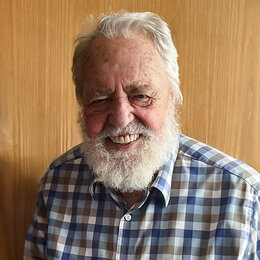
New Honorary Member 2026
Wolfgang Wiltschko
In recognition of his internationally groundbreaking research on the magnetic sense and orientation behavior of birds, his more than five decades of work for ornithology, as well as his many years of service on the board of the DOG.
Laudation
The German Ornithological Society confers honorary membership on Prof. Dr. Wolfgang Wiltschko and thus honors his outstanding, internationally groundbreaking research on the orientation behavior of birds as well as his impressive work of more than six decades as a scientist and university lecturer, through which he has decisively shaped ornithology both nationally and internationally. From 1992 to 1997, Wolfgang Wiltschko also served as President of our Society.
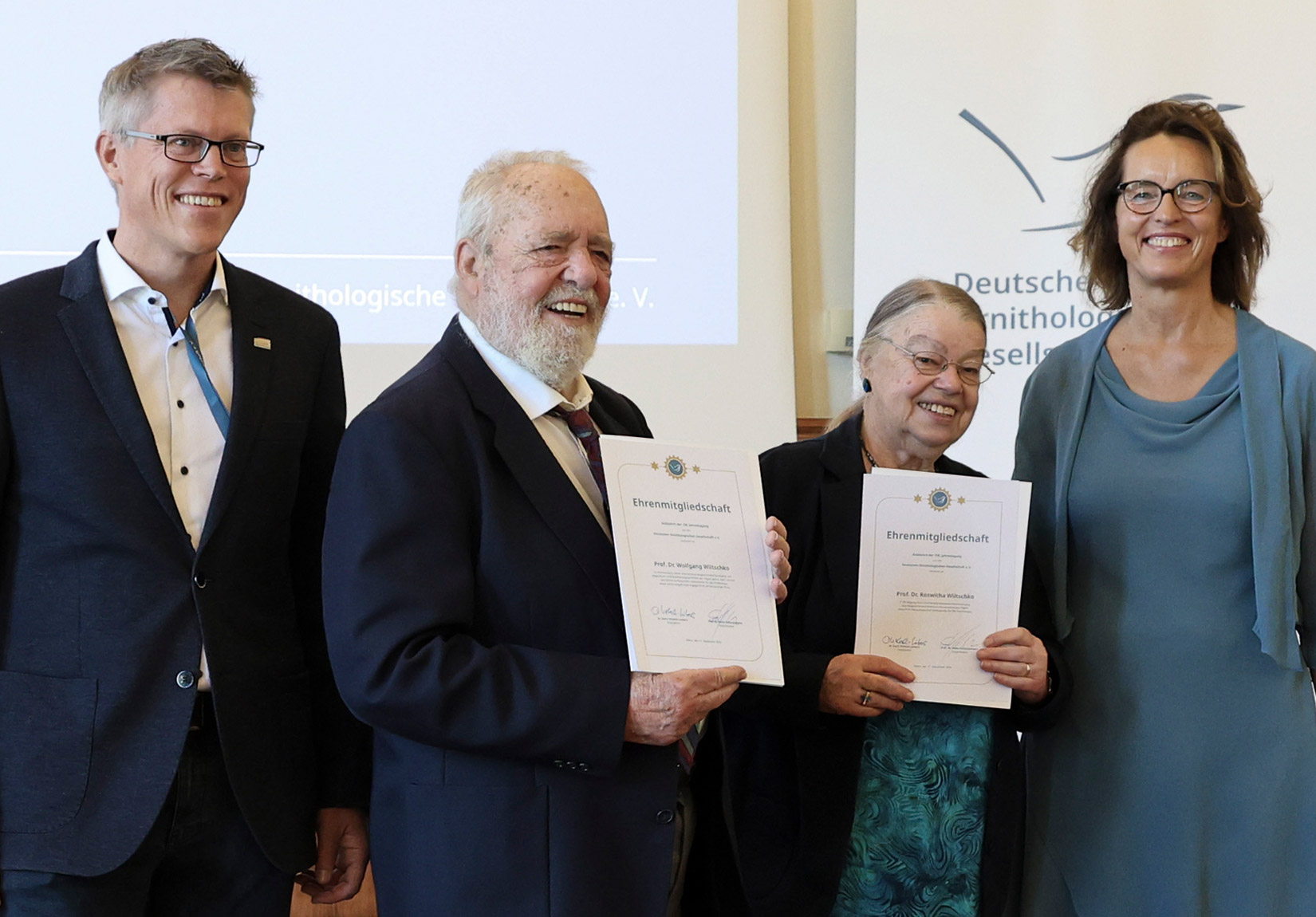
Awarding of honorary membership 2026 to Prof. Dr. Wolfgang Wiltschko (center left) and Prof. Dr. Roswitha Wiltschko (center right) by DOG President Dr. Dorit Visbeck-Liebers (right) and Prof. Dr. Heiko Schmaljohann (left), laudator and 1st Vice President of DOG.
Our knowledge that migratory birds use a “magnetic compass” to reach their migration destinations is due largely to the Wiltschkos, who developed their Frankfurt research group into one of the world’s leading centers for orientation biology. It was there that it was experimentally demonstrated for the first time anywhere in the world that birds can use the Earth’s magnetic field for orientation. In robins, it was shown how migratory birds in cages aligned themselves along their species-specific seasonal migratory direction and how this direction rotated with the artificial shift of the magnetic field produced by Helmholtz coils. This discovery was initially met with skepticism in the scientific community, but today it is regarded as one of the foundations of modern orientation research and as one of the most significant breakthroughs in behavioral biology of the 20th century.
Their joint research work, pursued consistently over more than five decades, is internationally highly esteemed and unique in its continuity. The Wiltschkos investigated how migratory birds and homing pigeons coordinate different compass mechanisms and how these systems interact. In doing so, they placed not only the magnetic sense at the center, but also sought to understand comprehensively how birds reach their migration destinations. This led to foundational studies on the inheritance of migratory direction, the homing ability of homing pigeons, and the importance of local experience, infrasound, and olfactory information for navigation. Their
research and review articles on the birds’ orientation system continue to shape generations of ornithologists today. In exemplary fashion, they combined elaborate fieldwork with precise laboratory work.
However, the Wiltschkos are regarded not only as pioneers in the study of the magnetic compass, or compass systems in birds, but, in collaboration with highly renowned national and international colleagues, also carried out pioneering work on the study of the physiological and neurobiological foundations of magnetoreception, which to this day is certainly among the most exciting and at the same time most enigmatic questions in sensory physiology.
The scientific achievement of Roswitha and Wolfgang Wiltschko is far more than a series of brilliant individual discoveries. It is an entire field of research that they helped found and decisively shaped over decades: the study of avian orientation as an independent, interdisciplinary discipline at the intersection of behavioral biology, sensory physiology, and physics. Their curiosity, methodological rigor, and persistence in the face of initial skepticism are exemplary for later generations of researchers. They are indeed “a biological original of a very rare kind.”
We warmly congratulate Wolfgang Wiltschko on an extraordinary scientific life’s work and thank him for everything he has given to ornithology – and to all of us who look with fascination at the journeys of migratory birds – and thus also to the German Ornithological Society, and has left with us forever.
Mainz, 17 September 2026
Dr. Dorit Visbeck-Liebers
President
Prof. Dr. Heiko Schmaljohann
Vice President