New extension of the Brehm Memorial opened
On 6 June 2026, the new glass extension of the Brehm Memorial in Renthendorf was ceremonially opened. Guests included representatives from politics, science and culture, among them former Thuringian Minister-President Bodo Ramelow as well as several state ministers, district administrators and mayors.
President Dorit Visbeck-Liebers delivered a welcome address on behalf of the Deutsche Ornithologische Gesellschaft. She recalled the special importance of Christian Ludwig Brehm for the history of German ornithology. When the DOG was founded in 1850, the "bird pastor" of Renthendorf was already regarded as one of the leading figures in his field. His observations, collections and publications remain among the foundations of scientific ornithology to this day.
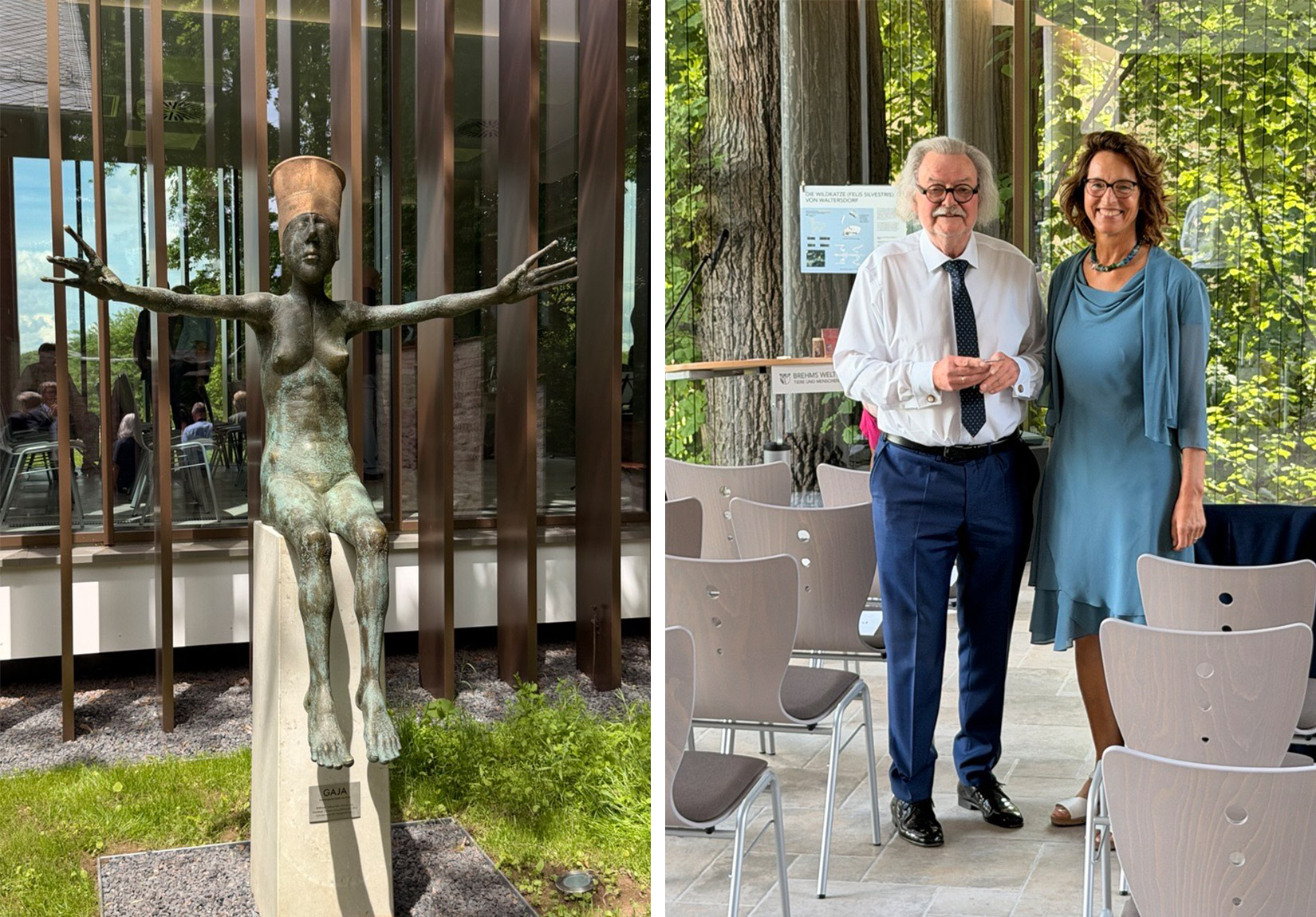
A special eye-catcher in front of the new building is the life-size bronze statue "Urmutter Gaja" by the sculptor Volkmar Kühn. Funded by the Free State of Thuringia, the sculpture commemorates Christian Ludwig Brehm, whose scientific achievements are today often overshadowed by the fame of his son Alfred Edmund Brehm. It honours the founder of one of the most important natural history collections of his time and helps to anchor his work more firmly in public awareness again.
However, the focus of her address was a topic that museum visitors often do not notice directly: archives and collections. As a curator at the German Oceanographic Museum in Stralsund, Dorit Visbeck-Liebers emphasised their importance as the "memory" of scientific institutions. They not only preserve objects and documents, but also create the conditions for history to be researched, questioned and contextualised again and again.
She particularly highlighted that a dedicated archive area has been created in the new building. This not only provides additional space for events and educational work, but also an important basis for the long-term preservation of sources and collection holdings.
In this context, the President also referred to the DOG's current work on its own history. Together with the Museum für Naturkunde Berlin, the society is working on a scientific reappraisal of its past, including the period of National Socialism. Such research is only possible if historical sources are preserved and accessible.
In conclusion, she congratulated the team of the Brehm Memorial led by Jochen Süss on the successful new building. It stands not only for the cultivation of the ornithological heritage, but also for the willingness to keep history alive and make it accessible to future generations.
Article by:
Dorit Visbeck-Liebers