


Meeting of the specialist group: Birds of agricultural landscapes
20–21 March 2026, Michael-Otto-Institut im NABU (MOIN), Bergenhusen
At the beginning, Heike Jeromin, acting head of the institute, welcomed the participants and outlined the main areas of work and current activities of MOIN. The program then continued with presentations, with this meeting focusing on the impact of pesticides.
To begin with, Martin Flade presented the results of a comparative study on pesticide contamination in the agricultural landscape. The occurrence of crop protection products in the soil of the large-scale organic farm near Brodowin (more than 2,000 hectares) in the Schorfheide-Chorin Biosphere Reserve differs significantly from that in a neighboring comparison area. However, air samples taken from the organic fields showed partially much higher pesticide levels, presumably caused by drift during periods of high-pressure weather conditions
The veterinarian Michael Lierz from the Bird Clinic at the University of Giessen presented the results of examinations of 70 dead house sparrows. By investigating disease and pesticide exposure, the causes of the decline of the house sparrow are to be clarified. However, most of the submitted birds were not fresh enough for examination, resulting in heterogeneous findings. There was no evidence of an epidemic event or any conspicuous pesticide exposure. House sparrows can still be submitted: https://nabu-naturgucker.de/meldeportal/naturbeobachtungen-melden/feldsperlinge/
Wieland Heim presented his project investigating the impact of pesticides on migratory birds. Using radio transmitters, the movement behavior of skylarks was recorded and pesticide exposure was determined in collected fecal samples from the tagged individuals. The project is based on a collaboration between Carl von Ossietzky University of Oldenburg and the Julius Kühn Institute, the Federal Research Centre for Cultivated Plants.
Eckhard Gottschalk presented the findings of studies on breeding attempts by skylarks. Pesticide-free areas (grassland, organic farming) were compared with skylark territories in conventionally farmed arable land. Delayed breeding onset and the lower number of breeding attempts on conventionally managed arable land differ significantly from breeding activity on uncontaminated areas.
Johanna Gundlach from the Federal Agency for Nature Conservation (BfN) reported on the current status of negotiations for the upcoming funding period of the EU Common Agricultural Policy. It became clear that agriculture will in future compete with other sectors for the former EAFRD funds. In addition, around 20 to 30 percent less funding will be available.
Rainer Dröschmeister from the BfN reported on the biodiversity and landscape quality indicator. The sub-indicator for agricultural land is taken into account in the National Strategy on Biological Diversity and used for the Restoration Regulation. Species selection, landscape scenarios, and target values have been reviewed and adjusted in recent years. The latest indicator value for 2023, with 77% target achievement, was far from the target, and no statistically significant trend over the past ten years can be identified. A stronger orientation of agricultural use toward sustainability and biodiversity conservation is urgently needed to achieve the target. The necessary measures, from reducing the use of crop protection products to more extensive management with sufficient fallow areas and the rewetting of wet grassland, are well known and must finally be implemented.
Kathrin Ronnenberg from the Thünen Institute of Biodiversity provided insight into her analyses, conducted together with Jannik Beninde, on the effectiveness of various agri-environment measures for plants and farmland birds. The focus was on determining the area required and the costs needed to achieve policy goals.
Lorenz Heldt explained the concept of “community meadow bird conservation” (Gemeinschaftlicher Wiesenvogelschutz, GWS) in Schleswig-Holstein. For many years, measures for nest protection and predator management for various wader species have been successfully implemented there. These include species in Germany that are on the brink of extinction, such as the curlew and the black-tailed godwit. In 2025, through the GWS, MOIN protected more than 1,530 nests from direct loss due to agriculture. After the lecture program on Friday, a visit was made to the Meggerkoog in the Eider-Treene-Sorge lowlands (ETS). Building on the previous presentation, Heike Jeromin and Jannik Beninde guided the group through the area. In particular, the practical work of the GWS was presented. The ETS is an important wintering area for Bewick’s swans on their way to their breeding grounds in the Russian Arctic, and large flocks of whooper swans were still present there. Various waders and ducks, as well as a short-eared owl, were also observed.
On the second day, Andreas Wiedenmann from the University of Göttingen presented an analysis of the federal states’ agri-environment programs with regard to their suitability for grey partridges and assessed the scope of the measures. According to this analysis, only a few measures can be fully recommended. Amelie Laux then showed that grey partridges do not have fixed territories, but rather change their home ranges much more over the course of the year than previously assumed. Birgit Becker from ABU Soest presented population trends of various meadow birds in North Rhine-Westphalia. Most species have become rarer over the past ten years. In addition, results from the LIFE project “Meadow Birds NRW” were presented. By the end of 2027, conservation measures for meadow birds will be implemented and researched there. A conference on this topic will be held in Münster from 13–15 November 2026.
On Saturday, Jannik Beninde, standing in for Sabine Urban, explained MOIN’s Bewick’s swan project, which investigates the causes of the decline in this species’ population. The northwestern European population of Bewick’s swan is declining sharply, mainly due to increased mortality, low breeding success, and the loss of suitable habitats during migration. Results from monitoring and tagging show that Bewick’s swans clearly prefer wetlands and protected areas and use them more frequently than unprotected areas. At the same time, the data reveal where conflicts and threats exist, especially from collisions with power lines. A map of the tagged swans can be found at https://zwergschwan.de/.
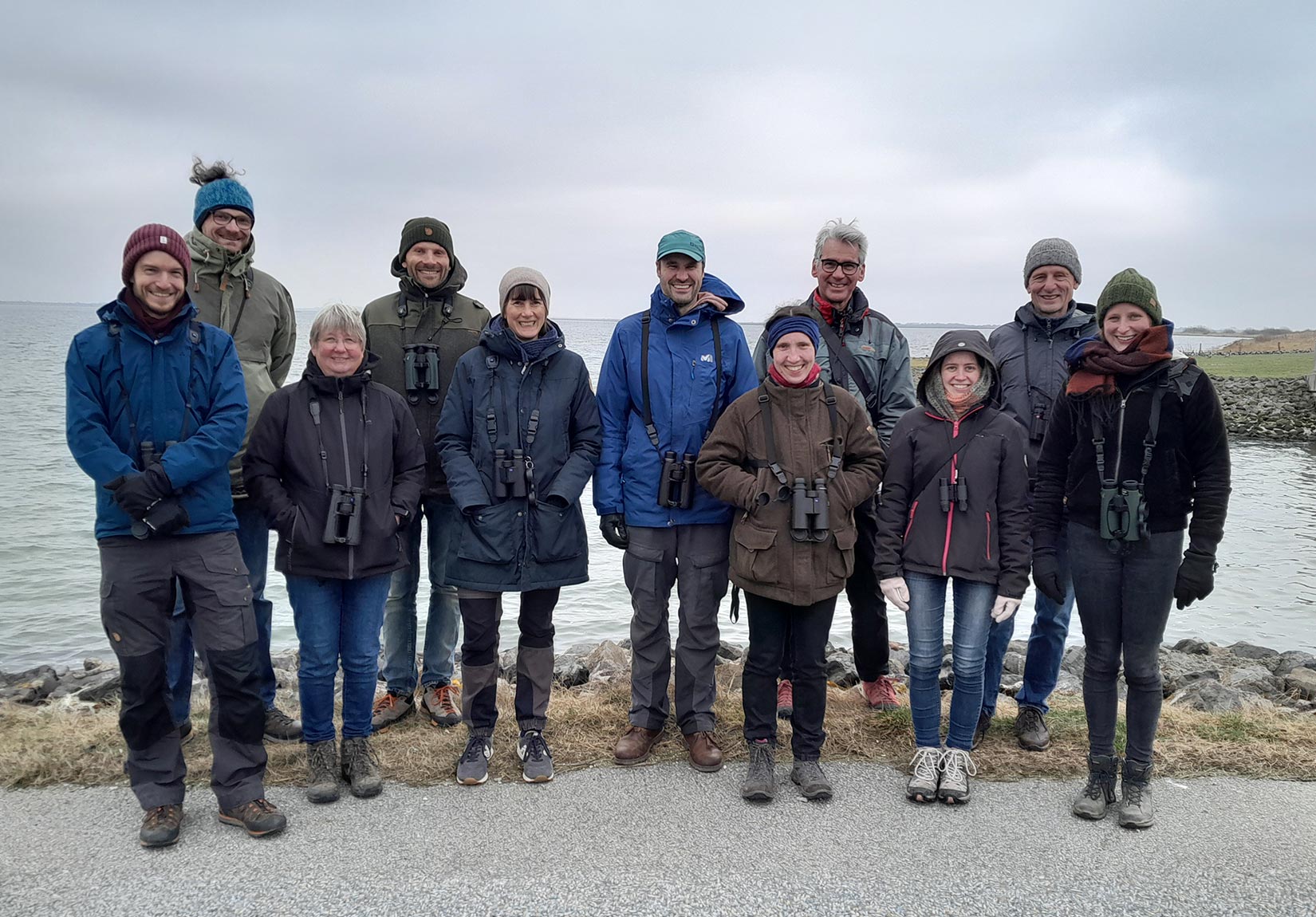
Dominic Cimiotti and Jolina Kröger presented the results of scientific monitoring and the conservation measures implemented by MOIN in Beltringharder Koog. This was followed by an excursion into the area. Under the expert guidance of Dominic, Jannik, and Jolina, the participants were led through the site and were able to observe a fascinating number of migratory and breeding bird species. The 3,350-hectare area is closely managed by MOIN and is protected in large parts by predator-control measures. A wide range of studies are conducted there, including telemetry on plovers and oystercatchers. The size of the area, the extensive management, and the large number of migratory and breeding birds impressed all participants.
Report by:
Lisa Dumpe, Eckhard Gottschalk, Jannik Beninde