


Neozoa Section
Objectives of the Special Interest Group
The Special Interest Group sees itself as a network of individuals engaged in scientific research on neozoa. Topics include both autoecological and synecological issues, ranging from habitat requirements to conflicts with other species and management measures. The focus may be on individual species at the local level, or on population trends across larger regions (e.g., federal states) as well as nationwide status classifications. Joint publications and symposia may be planned to facilitate knowledge exchange.
For those new to the topic: Neozoa are animal species that have become established in an area where they were not previously native as a result of human influence. When these species have a negative impact on the occurrence and populations of native species, they are referred to as invasive species. Especially when it comes to neozoa, public discourse often pits personal opinions against scientific facts.
Key Topics
- Scientific Exchange
- Assessment of Establishment and Invasiveness (Status Classifications)
- Overview of measures implemented in Germany to address neozoa
- Compilation of a literature review of publications on neozoa
Meetings and events
To ensure regular exchange, meetings take place both during the DO-G annual conventions and as separate (online) meetings.
Participation
Members of the SG can currently be reached via an email list. Anyone who is interested in taking part or knows someone who would like to join is welcome to send us a message or contact one of the spokespersons of the specialist group.
We welcome new members and ideas. Ultimately, the specialist group only lives through the activities of its members.




Publications – Statements – Documents
Completing this list is a goal of the SG. Suggestions for inclusion are collected by Stefan Sudman and Friederike Woog and added here as required.
The following articles in the special issue of Der Falke "Neozoen – gefiederte Neubürger" (2020) were written by non-members of the DOG.
Gebietsfremde Vögel in Deutschland: Harmlose Neubürger oder aggressive Invasoren?
Friederike Woog, Hans-Günther Bauer
Rheinstädte in Baden-Württemberg, Rheinland-Pfalz, Hessen, Nordrhein-Westfalen: Neue Heimat tropischer Papageien
Michael P. Braun, Nicole Braun, Detlev Franz
Vogelneozoen – eine europäische Übersicht
Verena Keller, Hans-Günther Bauer, Sergi Herrando, Petr Voříšek
Schwarzkopfruderente trifft Weißkopfruderente: Die teuerste Ente der Welt
Friederike Woog
Problem oder Bereicherung? Gänse aus aller Welt
Helmut Kruckenberg
Papageien im Schwabenländle: Die Stuttgarter Amazonen
Johanne Marie Martens
Vom Monitoring zum Management: Nandus in Mecklenburg-Vorpommern
Arne Korthals, Frank Philipp
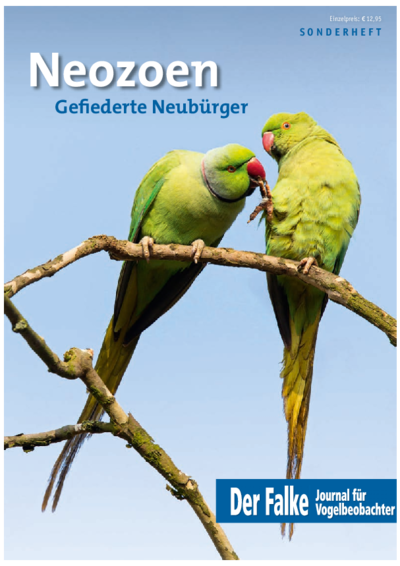
Der Falke – special issue on neozoa
Gefiederte Neubürger (feathered newcomers)
 Download magazin

Der Falke – special issue on neozoa
Status assessments
Vogelneozoen in Deutschland – Revision der nationalen Statuseinstufungen
Bauer, H-G., Geiter, O., Homma, S. & F. Woog (2016)
Vogelwarte 54: 165 – 179
Naturschutzfachliche Invasivitätsbewertungen für in Deutschland wild lebende gebietsfremde Wirbeltiere, III Steckbriefe
Rabitsch W, Nehring S, Wolter C, Bauer H-G, Woog F, Homma S, Wiesner C, Martens H, Michler F-U (2015)
BfN-Skripten 409: 43-145
Zur Invasivität gebietsfremder Vogelarten und deren Status und Ökologie in Deutschland
Bauer, H.-G. & F. Woog F. (2012)
Vogelwarte 50 (4): 311-312
On the „invasiveness“ of non-native bird species
Bauer, H.-G. und F. Woog (2011)
Ibis 153 (1) 204–206
Nichtheimische Vogelarten (Neozoen) in Deutschland
Bauer, H. G. & F. Woog (2008)
Vogelwarte 46: 157-194
Parrots
Neozoen in urbanen Habitaten: Ökologie und Nischenexpansion des Halsbandsittichs (Psittacula krameri Scopoli 1769) in Heidelberg
Braun, M. (2004)
Diplomarbeit., Universität Marburg.
Welchen Einfluss hat die Gebäudedämmung im Rahmen des EU-Klimaschutzes auf die Brutbiologie tropischer Halsbandsittiche (Psittacula krameri) im gemäßigten Mitteleuropa?
Braun, M. (2007)
Ornithol. Jh. Bad.-Württ. 23: 87–104
Die Bestandssituation des Halsbandsittichs Psittacula krameri in der Rhein-Neckar-Region (Baden-Württemberg, Rheinland-Pfalz, Hessen), 1962-2008, im Kontext der gesamteuropäischen Verbreitung.
Braun, M. (2009)
Vogelwelt 130: 77–89
Nestling development of ring-necked parakeets (Psittacula krameri) in a nest box population.
Braun, M. P. & Wink, M. (2013)
The Open Ornithology Journal, 6(1)
Monitoring of free-ranging and captive Psittacula populations in Western Europe for avian bornaviruses, circoviruses and polyomaviruses.
Kessler, S., Heenemann, K., Krause, T., Twietmeyer, S., Fuchs, J., Lierz, M., ... & Rubbenstroth, D. (2020)
Avian Pathology 49: 119–130
Halsbandsittiche Psittacula krameri am Schlafplatz in Bonn: Anzahl, jahreszeitliche Schwankungen und Einflugzeiten.
Koch, E., Schidelko, K., & Stiels, D. (2013)
Charadrius, 49, 150–155.
Nest cavity characteristics, reproductive output and population trend of naturalised Amazon parrots in Germany.
Martens, J.M. & F. Woog (2017)
Journal of Ornithology DOI 10.1007/s10336-017-1436-9
Diet and feeding behaviour of naturalised amazon parrots in a European city.
Martens, J., Hoppe, D., & Woog, F. (2013)
Ardea, 101(1), 71–76
Waterbirds
Comparing behavioural responses of Greylag Geese Anser anser and Egyptian Geese Alopochen agyptiacus to human disturbance in an urban setting.
Comparing behavioural responses of Greylag Geese Anser
Wildfowl 71: 244–261
How aggressive are Egyptian Geese Alopochen aegyptiaca? Interactions with Greylag Geese Anser anser and other birds in an urban environment.
Hohmann, R. & Woog, F. 2021b
Wildfowl 71: 234–243
Schwerpunktheft zur Problematik der Vorkommen von Graugans Anser anser, Kanadagans Branta canadensis und Nilgans Alopochen aegyptiaca in Nordrhein-Westfalen
Jöbges, M. M., Herkenrath, P., Koffijberg, K., & Sudmann, S. R. (2018)
Charadrius 54, 145–150
Increased immune marker variance in a population of invasive birds.
Prüter, H., Franz, M., Twietmeyer, S., Böhm, N., Middendorff, G., Portas, R., ... & Czirják, G. Á. (2020)
Scientific Reports 10: 21764
Other species
Predicting the potential distribution of the invasive Common Waxbill Estrilda astrild (Passeriformes: Estrildidae)
Stiels, D., Schidelko, K., Engler, J. O., van den Elzen, R., & Rödder, D. (2011)
Journal of Ornithology 152: 769–780
Niche shift in four non-native estrildid finches and implications for species distribution models.
Stiels, D., Gaißer, B., Schidelko, K., Engler, J. O., & Rödder, D. (2015)
Ibis 157: 75–90