


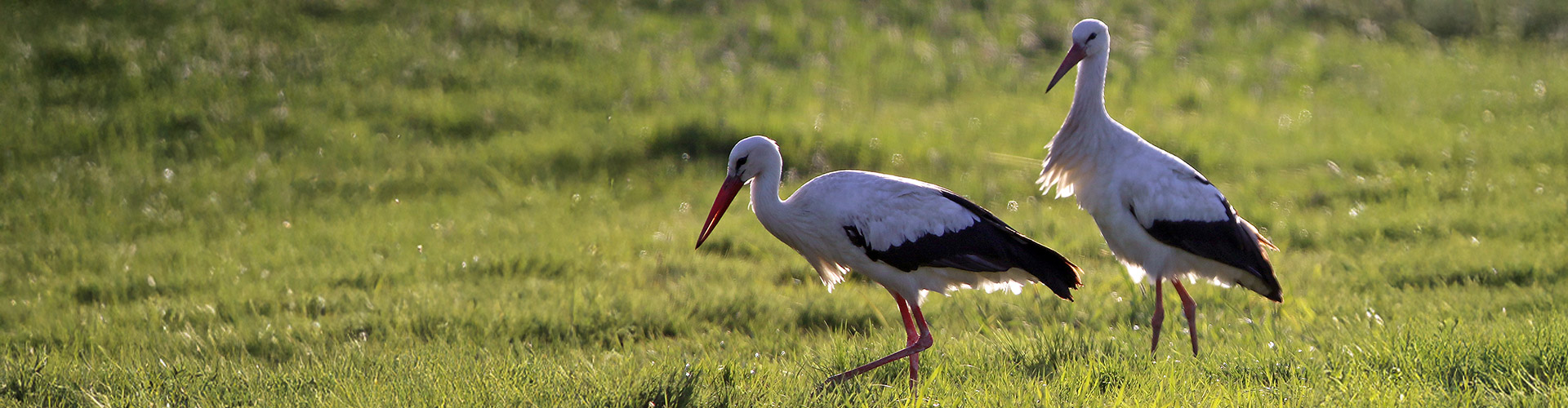
33rd Saxony-Anhalt Stork Days, October 16–18, 2026, in Loburg and Möckern
On October 17, 2026, DOG President Dr. Dorit Visbeck-Liebers attended the 33rd Saxony-Anhalt Stork Days in Möckern as a guest. Under the motto “Between Tradition and Modernity,” experts and volunteers came together to exchange ideas on stork research and conservation. She delivered the DOG’s greetings at the opening.


Left: Christoph Kaatz in his welcoming speech at the 33rd Saxony-Anhalt Stork Days in Möckern. Right: DOG President Dr. Dorit Visbeck-Liebers (left) after her greeting, together with Michael Kaatz (center) and Andrea Flack (right).
Welcome Address for the 33rd Stork Day in Saxony-Anhalt
Dear friends of storks,
On the occasion of the 33rd Saxony-Anhalt Stork Days, I send you warm greetings on behalf of the German Ornithological Society.
Your motto, “Between Tradition and Modernity,” ties in directly with our most recent annual meeting of the DOG in Mainz. There, Martin Wikelski demonstrated how modern tracking technology makes it possible to study bird migration across continents. Wolfgang Fiedler presented findings collected together with Andreas Flack: young white storks learn from conspecifics, improve their flight strategies with increasing experience, and develop individual migration routes. Ringing, long-term observation, and modern transmitter technology provide an ever more precise view of the different life histories.
The famous 1822 arrow stork in the University Collection Rostock provided an early, concrete piece of evidence for long-distance migration between Europe and Africa. Its story is also taken up by the new film “Watching People Watching Birds,” which we were able to see as a preview in Mainz. From this single observation to today’s research on bird migration, the arc is truly impressive.
White storks are also ambassadors through whom we can inspire people for bird migration research and nature conservation. In my home region of Stralsund, I experience this as well with cranes: their calls and large communal stopovers make bird migration immediately tangible. Encounters like these arouse curiosity and create points of contact for bringing scientific findings to the public.
I would like to express my special thanks to everyone who volunteers for storks. Your local knowledge, your long-standing observations, and your work for nests and habitats are an indispensable foundation for research and conservation.
This link between volunteer commitment and professional research is especially important to the DOG as well. It offers dedicated ornithologists a scientific home and opportunities to pursue their own questions, make contacts, and exchange experiences. We support especially young members with travel grants and the promotion of research trips. Our newly launched funding program for guest visits creates additional opportunities to learn at other institutions and conduct research together.
I cordially invite you to help shape this exchange and make use of the DOG’s offerings. For much can grow from enthusiasm for birds, local knowledge, and new scientific ideas.
I would like to thank the team at Storchenhof Loburg for organizing this event and wish all participants stimulating presentations, good conversations, and new impulses for our shared white stork conservation.
Dr. Dorit Visbeck-Liebers
President of the German Ornithological Society
October 1, 2026